Guide
Painting Contractor Profit Margins: What to Watch
4 min read · Updated
A job can generate sales without generating much profit. To judge whether a painting estimate is sustainable, you need to know what the job costs, which business expenses it must help cover, and what remains at the price you plan to charge. The first step is to stop treating markup and margin as interchangeable.
1. Understand the terms before using a target percentage
- Direct job costs are costs attributable to the job, such as direct labour, materials, consumables, job-specific equipment and subcontractors.
- Gross profit is selling revenue minus direct job costs. Gross margin is gross profit divided by selling revenue.
- Overhead is the ongoing cost of operating the business that may not belong directly to one job, such as administration, some vehicle expenses and general marketing. Use a consistent method to recover it across your work.
- Operating profit for an estimating model is the revenue left after direct job costs and allocated operating overhead. This simplified calculation is not a full financial-statement profit measure and may exclude financing, tax and other items.
- Markup describes how much is added relative to cost. Margin measures how much of the selling price remains after the costs included in the calculation.
2. Apply the formulas correctly
Markup % = (selling price − cost) ÷ cost × 100
Margin % = (selling price − cost) ÷ selling price × 100
Selling price for a target margin = cost ÷ (1 − target margin as a decimal)
A 25% markup on a cost of 100 produces a price of 125; the margin is 20%, not 25%. To obtain a 25% margin on that same cost basis, the selling price must be 100 ÷ 0.75 = 133.33 (subject to rounding).
The word cost must be defined consistently. A gross margin uses direct costs; an after-overhead operating margin uses direct costs plus allocated overhead. Comparing two different margin measures without naming their cost basis is misleading.
3. Worked example: cost, price and margin
All amounts below are hypothetical cost units, not typical painting-job prices or recommended profit targets.
| Item | Amount |
|---|---|
| Direct labour and materials combined | 2,000 |
| Allocated operating overhead | 400 |
| Cost basis for target after-overhead margin | 2,400 |
Suppose the contractor independently chooses a 25% target margin after those included costs. Then:
Selling price = 2,400 ÷ 0.75 = 3,200
Gross profit against direct costs = 3,200 − 2,000 = 1,200
Gross margin = 1,200 ÷ 3,200 = 37.5%
Simplified operating profit after allocated overhead = 3,200 − 2,400 = 800
Simplified margin after that overhead = 800 ÷ 3,200 = 25%
These are two different margins and should be labelled accordingly. The 25% is just a chosen illustrative target; it is not an industry standard or a promise of profitability.
4. What happens when you discount?
Before approving a discount, check whether scope, material specification or access can legitimately change, and whether the revised agreement will still meet your business's objectives. Never quietly reduce coats or preparation that the customer expects to receive.
5. Common causes of understated costs
Profit projections are unreliable when labour hours omit preparation or cleanup, product coverage is assumed instead of checked, trim and access work are undercounted, repairs have no clear change process, or overhead is forgotten. Another risk is entering an unrealistically low hourly cost for your crew or treating the owner's own labour as free — the labour cost guide shows how to calculate it.
The Painting Contractors Association recommends validating labour, materials, job details and costs before submitting a proposal. Use actual completed-job data to check whether your cost assumptions hold up after work begins.
6. Use QuoteGuard appropriately
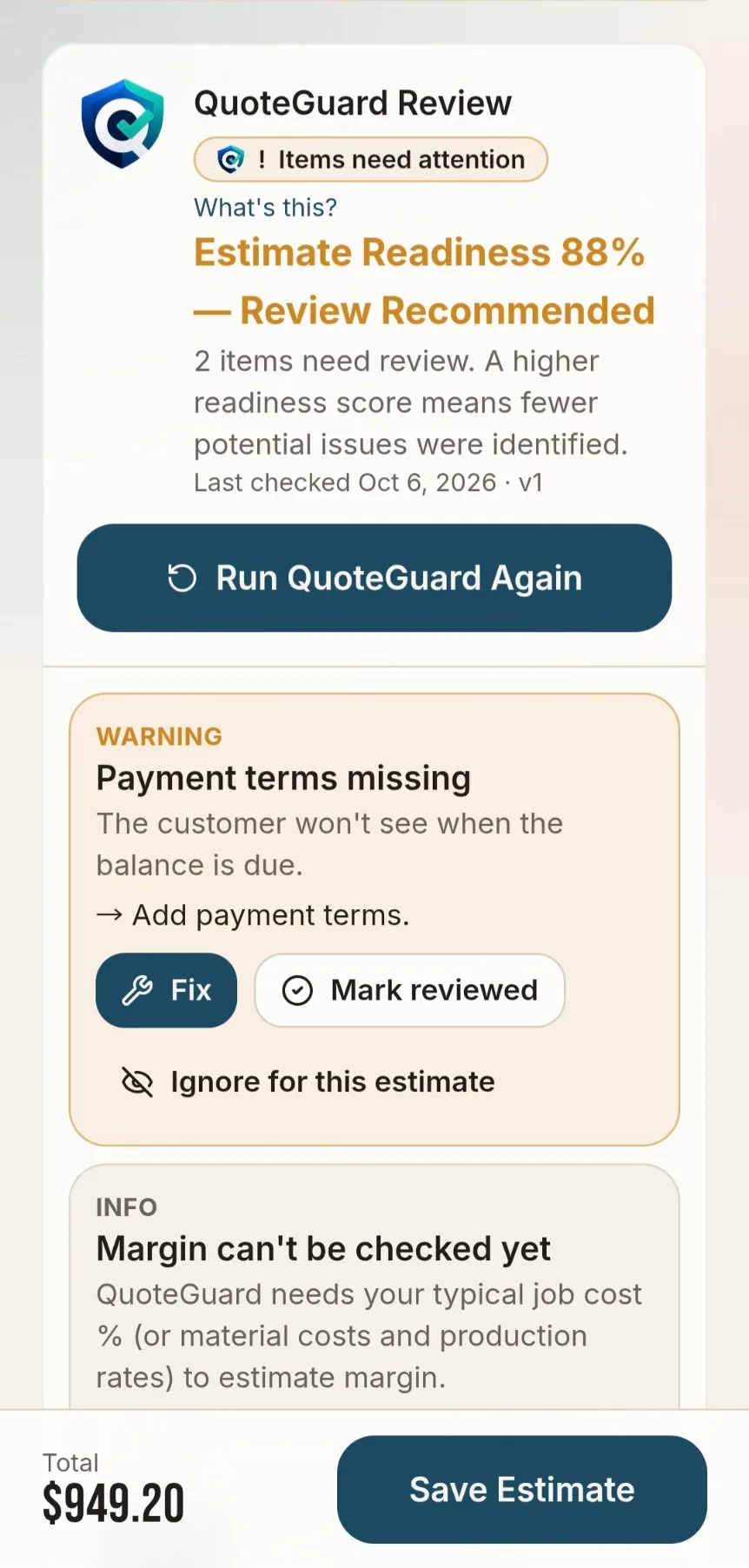
CoatMetric applies the prices and assumptions the contractor enters. Its QuoteGuard feature can identify potential margin concerns when enough cost information has been entered. If key information is missing, it may not be able to evaluate margin. The result is an advisory prompt to review, not an independent cost audit or guarantee of profit. QuoteGuard is included on Pro and Team and during the 14-day Pro trial.
Final margin check
- Define whether you're evaluating gross margin or margin after allocated overhead.
- Verify direct labour, materials, access, equipment and subcontractors.
- Make overhead recovery explicit and avoid double counting.
- Calculate selling price using the formula appropriate to your selected target.
- Recalculate after discounts, scope changes or material substitutions.
- Compare estimated and actual job results after completion.
For the pricing mistakes that most often erode margin, see common painting quote mistakes.
Frequently asked questions
What margin should a painting contractor target?
There's no universal number. It depends on your overhead, market and business goals. Calculate the margin you need from your own costs, and name the cost basis you're using.
Sources checked
Related pages
Move beyond spreadsheet estimates
CoatMetric helps you measure, price from your own rates, review with QuoteGuard and send signable proposals. Try it free for 14 days with full Pro access — no credit card required.